
Temperature Transmitters
Modern temperature transmitters offer significant advantages over traditional direct-wired solutions. By eliminating the need for specialized cabling, they streamline installation, reduce engineering complexity, and minimize ongoing maintenance requirements. In addition, these transmitters provide advanced diagnostic capabilities, improving reliability and enabling predictive maintenance for critical processes.
To address diverse industrial needs, Aditi Process Solutions offers a full range of temperature transmitters, including head-mount, panel-mount, and field-mount devices, ensuring accurate and stable performance across a wide variety of applications.
RTD (Resistance Temperature Detectors)

RTDs provide precise, repeatable temperature measurement using the predictable change in resistance of platinum elements—ideal for –200…+600 °C (up to +850 °C with special constructions) across utilities, process, and hygienic applications.
- Elements: Platinum Pt100 / Pt1000, thin-film and wire-wound; tolerances IEC 60751 Class A/B, optional 1/3 DIN / 1/10 DIN.
- Wiring: 2-wire (short runs), 3-wire (industrial standard), 4-wire (highest accuracy)
- Mineral-insulated (MI) probe with sheath (Ø3–8 mm) for fast response & vibration resistance.
- Spring-loaded insert for thermowells (DIN form).
- Sanitary/CIP designs (Tri-Clamp, polished Ra ≤ 0.8 µm).
- Surface/bearing/contact sensors (ring lug, pad, clamp-on).
- High-temp / cryogenic variants, duplex (two elements in one probe) for redundancy.
- Materials & connections: 316/316L sheath as standard; special alloys on request. Threads ½” NPT / M20, flanged, or Tri-Clamp ferrules.
- Heads & enclosures: DIN Form B heads (Alu/SS/plastic), IP66/67; options for head-mount transmitters or remote/field-mount transmitters.
- Certificates: traceable calibration, material test certificates, hygienic documentation
Thermocouples

Thermocouples (TCs) are rugged, fast-response temperature sensors that generate a tiny voltage from the Seebeck effect at the junction of two dissimilar metals. They cover very wide ranges (approx. –200 to +1700 °C, model-dependent), tolerate vibration, and are easy to integrate with transmitters, indicators, and PLC/DCS systems.
- The sensing (hot) junction is at the process; the instrument provides a cold-junction reference (CJC) and converts microvolts to °C/°F.
- Use extension/compensating cable that matches the TC type all the way to the CJC point to avoid errors.
- Polarity matters: the negative leg is typically magnetic for base-metal TCs (check local color codes).
Field Mount
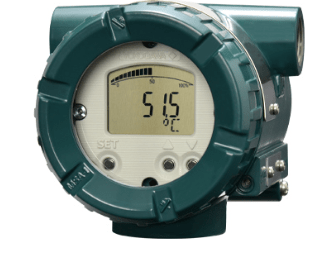
Field-mount temperature transmitters place the electronics in a rugged, sealed housing away from heat/vibration at the probe, giving you stable, accurate measurements with a local display and easy access for maintenance—ideal for harsh outdoor and process areas.
- Inputs: RTD (Pt100/500/1000; 2/3/4-wire), Thermocouples (K, J, N, E, T, R, S, B), mV/Ω.
- Dual-sensor modes: backup (failover), average, sensor drift monitoring (ΔT).
- Accuracy & linearization: IEC 60751, Callendar–Van Dusen sensor matching; automatic cold-junction compensation.
- Outputs & protocols: 4–20 mA (HART) loop-powered; options for Modbus/Fieldbus; NAMUR NE43 burnout (up/downscale).
- Diagnostics: sensor open/short, NE107 status, lead-wire compensation, ambient temp monitoring.
- Environmental: IP66/67 / NEMA 4X, –40…+85 °C ambient (typ.), surge/transient protection, UV-resistant coatings.
- Hazardous areas: Ex ia/ib (IS), Ex d (flameproof), Division/Zone approvals (model-dependent).
- Enclosures & entries: aluminum or stainless steel, dual-compartment design, ½” NPT / M20 entries; pipe/wall mounting kits.
- Interface: large LCD (optionally backlit), push-buttons or handheld/remote configuration.
Head Mount

Head-mount (“hockey-puck”) transmitters fit inside a DIN Form B connection head, converting RTD/thermocouple signals to a robust 4–20 mA (HART) or digital output right at the sensor. This minimizes noise, improves accuracy, and keeps installations compact and cost-effective.
- Inputs: RTD (Pt100/500/1000; 2/3/4-wire), Thermocouple (K, J, N, E, T, R, S, B), mV/Ω.
- Accuracy & stability: IEC 60751 compliance, Callendar–Van Dusen matching for RTDs, automatic CJC for TCs.
- Smart functions: dual-sensor modes (backup/average/difference), drift detection, filtering/damping, upscale/downscale NAMUR NE43 burnout.
- Outputs & comms: loop-powered 4–20 mA (HART); options for Modbus/Fieldbus variants.
- Diagnostics: sensor open/short, out-of-range, ambient monitoring, NE107 status.
- Approvals: Ex ia/ib (intrinsically safe) and other hazardous-area certifications available.
- Form factor: DIN Form B mounting plate; optional plug-on head display or remote indicator.
Panel Mount
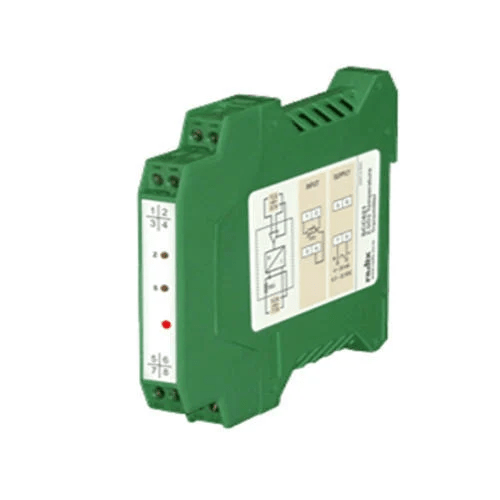
Panel-mount (rack/indicator) transmitters put signal conditioning and visualization in your control panel, converting RTD/thermocouple inputs to stable 4–20 mA (HART passthrough optional) or digital outputs—ideal when you want local display, alarms, and easy access for operators and maintenance.
- Universal inputs: RTD (Pt100/500/1000; 2/3/4-wire), Thermocouples (K, J, N, E, T, R, S, B), mV/Ω.
- Accurate & stable: IEC 60751 linearization, Callendar–Van Dusen matching, automatic CJC for TCs; low drift over time/temperature.
- Outputs & comms: 4–20 mA retransmission, pulse/relay for alarms, RS-485/Modbus RTU; some models support HART transparent mode.
- Display & interface: bright LED/LCD, engineering units, bargraph/totalizer; front-panel keys for quick configuration (password lockable).
- Alarms & logic: dual/triple relays (high/low, deviation, rate-of-change), sensor burnout up/downscale (NAMUR NE43).
- Isolation & safety: 3- or 4-port galvanic isolation; surge/EMC protection; UL/CE options.
- Form factors: 1/8 DIN (96×48 mm) most common; also 1/4 DIN (96×96) and slim controllers for dense panels; detachable terminals.
Thermowell
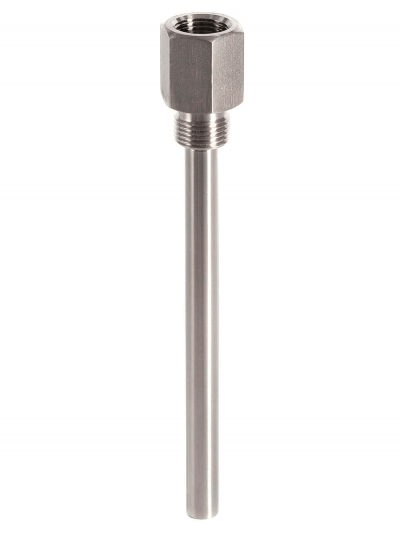
Thermowells are protective housings for RTDs and thermocouples, allowing sensor removal without breaking process containment. Correctly engineered thermowells improve safety, sensor life, and measurement integrity under pressure, velocity, corrosion, and erosion.
- Process connections: Threaded (½″/¾″ NPT, BSPP/BSPT), Flanged (RF/RTJ; ASME/EN), Socket-weld, Weld-in, Sanitary Tri-Clamp, Van-Stone/lap-joint.
- Shank profiles: Straight, Tapered (best for high velocity/steam), Stepped (fast response with adequate strength).
- Tips & extensions: reduced-tip (fast response), spear/ogive, lagging extensions for insulated lines, velocity collars for nozzle support.
- Bore/insert options: 6–8 mm bores for MI probes; spring-loaded DIN inserts for positive tip contact; single/duplex sensors.
- Materials & linings: 316/316L, 304, 321/347, 310 SS, Duplex/Super Duplex, Inconel® 600/625/800, Hastelloy® C-276, Monel® 400, Titanium; PTFE/PFA sleeves or tantalum cladding for aggressive media.
- Documentation: GA drawings, MTCs, hydrotest notes (if required), traceable calibration (sensor), NACE MR0175/ISO 15156 compliance for sour service, hygienic certificates (3-A/EHEDG) where applicable.
Industrial Temperature Measurement
Temperature is one of the four fundamental process variables, alongside pressure, level, and flow. Accurate temperature measurement plays a critical role across a wide range of industrial applications—from chemical processing and power generation to food production and pharmaceuticals. Even small inaccuracies can significantly impact efficiency, product quality, and operating costs.
Consider this example: if a controller is programmed to maintain water at 100°F, but the temperature reading received is just 1°F lower than the actual value, the controller will supply additional unnecessary energy to the process. While the discrepancy may appear minor, over a year of continuous operation with large volumes (100,000+ units annually), this could translate into thousands of dollars in wasted energy costs—$8,000, $10,000, or even more, depending on the scale. Such hidden losses make temperature accuracy an often overlooked but essential factor in cost control and operational efficiency.
Because of this, having a reliable and precise temperature measurement system is critical. Temperature sensors—such as thermocouples, RTDs, and thermistors—form the foundation of measurement. However, when paired with a temperature transmitter, accuracy, signal integrity, and overall system reliability are greatly enhanced. Transmitters convert the raw sensor signal into a standardized output (such as 4–20 mA or digital protocols), ensuring stable transmission over long distances, reducing noise interference, and enabling advanced diagnostics.
Differences Between RTDs and Thermocouples
Resistance Temperature Detectors (RTDs):
RTDs operate on the principle that the electrical resistance of a material changes predictably with temperature. By measuring this resistance and applying the known resistance–temperature relationship, the actual temperature can be determined.
- Materials: The most common material used is Platinum, due to its stability, precision, and well-defined resistance change across a wide temperature range. Other materials can be used, but platinum remains the industry standard for high accuracy applications.
- Advantages: RTDs are valued for their high accuracy, excellent stability, and repeatability over long periods, making them ideal for processes where precision is critical.
- Limitations: They tend to have a higher initial cost, slower response time, and a more limited temperature measurement range compared to thermocouples.
Thermocouples:
Thermocouples work on a different principle. They consist of two dissimilar metals joined at one end. When the junction is exposed to heat, it generates a voltage (known as the Seebeck effect), which can be correlated to temperature using standard reference tables.
- Materials: A wide variety of metal combinations are used, such as Type K (Chromel–Alumel), Type J (Iron–Constantan), and others. Each combination provides a different temperature range and performance characteristic.
- Advantages: Thermocouples are generally more rugged, less expensive, faster responding, and capable of measuring across a much wider temperature range than RTDs.
- Limitations: They are less stable over time, and their accuracy tends to degrade with prolonged use in harsh environments, especially at high temperatures.
 Aditi Process Solutions